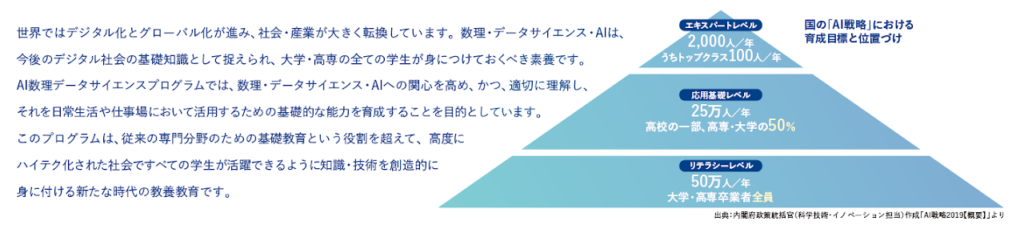
In April 2022, Chubu University set up a literacy level for a “new education program” to learn AI, mathematics, and data science from the basics
. is taking the course.
In April 2023, we will set up a new basic level of applied education with a higher level of education.
This program is designed based on the accreditation standards of the Ministry of Education, Culture, Sports, Science and Technology’s “Mathematics, Data Science and AI Education Program”, the same as the literacy level.
At the basic applied level, students learn literacy level education in a complementary and developmental way, positioned as a “bridging education” that connects literacy level education and specialized education .
Students will acquire the ability to utilize data and provide feedback to the field, as well as the basic ability to solve problems with AI, and acquire a broader perspective to apply mathematics, data science, and AI to their own specialized fields .
Regardless of whether you are in the humanities or the sciences, let’s acquire the problem-solving skills that are essential for society in the future by analyzing big data.
Mathematics/Data Science/AI Education Program Certification System
Systematic education on knowledge and technology for the purpose of developing basic skills to appropriately understand and utilize mathematics, data science, and AI, and to develop practical skills to solve problems. This is a system in which the Minister of Education, Culture, Sports, Science and Technology certifies, selects, and encourages universities that conduct At Chubu University, we plan to apply for certification in August 2023 for the literacy level and in August 2024 for the applied basic level.
Reference: Ministry of Education, Culture, Sports, Science and Technology HP “Mathematics, Data Science, AI Education Program Certification System”

About program registration (free)
This program is for all incoming students from 2022 onwards. Students who wish to register should apply for registration at the designated time designated by the university.
The course can be taken within the credits required for graduation and is free of charge.
Course registration flow
Literacy Level Completion Requirements
Spring semester of first year (compulsory)
Skill education subjects
Utilization of Information Skills (University Common Education Subject)
Use of Chubu University’s unique systems such as campus networks and library databases, general knowledge of PCs, management and operation methods, basic operations of Microsoft Office, network security and information ethics, etc. At the same time, learn about AI and data science. Acquire introductory knowledge.
Acquire 4 credits (2 subjects) or more from the following 3 elective subjects (after the fall semester of the first year)
Skill education subjects
Utilization of Information Skills (University Common Education Subject)
Through practical training using various applications, students develop problem-solving, logical thinking, and data processing skills, and learn the skills required at university and in society, such as persuasive report writing and presentations. You will also learn about cutting-edge topics such as AI and data science.
Skill education subjects
Mathematics for Data Science (University Common Education Subject)
Students learn the basics of mathematics, which are essential for mastering mathematical science and data science, regardless of whether they are in the humanities or sciences. In addition to the concepts, students will learn practical calculation methods using mathematical formula manipulation software, as well as differential methods and basic matrix calculation methods. In addition, you will learn about partial differentiation, optimization problems, and the basics of machine learning.
science and technology literacy
Introduction to Statistics for Problem Solving (University Common Education Subject)
Students will learn the basics of various aspects of “mathematics, data science, and AI,” which are ongoing social changes, and acquire the ability to analyze real-world issues based on statistics. In addition, considering that various students will take the course, students will learn the range that can be understood with basic mathematics.
together with compulsory 6 credits or more in total acquisition
Obtaining a Certificate of Completion upon Graduation

About program registration (free)
This program is for students who will enroll in the 2023 academic year or later. This program consists of science and technology education subjects that are common subjects for the Faculty of Engineering and the Faculty of Science and Engineering, but students outside the Faculty of Engineering and Faculty of Science and Technology can also take the course. Students who wish to register should apply for registration at the designated time designated by the university. The course can be taken within the credits required for graduation and is free of charge.
Course registration flow
Applied Basic Level Completion Requirements
Acquire all of the following 13 credits (6 subjects)
Linear Algebra (3 credits) (Science and Engineering Subjects)
Quantitative data, which plays a major role not only in natural sciences and engineering, but also in almost all fields such as economics and social sciences, can be viewed as vectors in high-dimensional space. Learn about vectors, their linear transformations, and matrices that express linear equations, and cultivate basic ability to handle big data.
Mathematical Science A (2 credits) (Science and Engineering Subjects)
You will study a wide range of basic mathematical models such as differential equation models, stochastic models, and network models, and learn the basics of mathematical science in general. Through learning about the knowledge and effectiveness of mathematical models and data analysis methods, students will learn how to think about mathematical models that make mathematics useful to society.
Utilization of Artificial Intelligence Algorithms (2 credits) (Science and Engineering Subjects)
Students learn the concepts, mechanisms, and algorithms of machine learning and deep learning, which are the foundation of artificial intelligence (AI) technology, and acquire basic knowledge of AI technology. Furthermore, by learning about machine learning and deep learning application examples, students will acquire the knowledge to introduce and utilize AI technology in business and research and development.
Fundamentals of Data Science (2 credits) (Science and Engineering Subjects)
In this lecture, we will learn probability statistics, which is the foundation of data science. The goal is to develop an understanding of the basic concepts of probability and statistics and how to use them to deal with problems with uncertainty. In particular, we will understand the characteristics of various probability distributions and learn the basics of statistical estimation and statistical testing.
Data Science Programming (1 credit) (Science and Engineering Subjects)
In order to be able to practice data science, students will learn how to develop ICT and big data, how to collect data, how to express data on computers, and how to handle it. In addition, in order to analyze and utilize data to solve problems, students will learn the relationship with artificial intelligence and programming methods.
Required subjects above All 13 credits total acquisition
Obtaining a Certificate of Completion upon Graduation
System for improving and evolving the Chubu University AI Mathematics Data Science Program
| Operation manager | Director of AI Mathematical Data Science Center |
| Program improvement and evolution | AI Mathematical Data Science Program Steering Committee |
| Program self-inspection and evaluation | AI Mathematical Data Science Program Steering Committee |
Results of self-inspection and evaluation
Reference
- “Mathematics/Data Science/AI (literacy level) Model Curriculum”
(Mathematics/Data Science Education Enhancement Base Consortium) - “Mathematics/Data Science/AI (Applied Fundamental Level) Model Curriculum”
(Mathematics/Data Science Education Enhancement Base Consortium)